
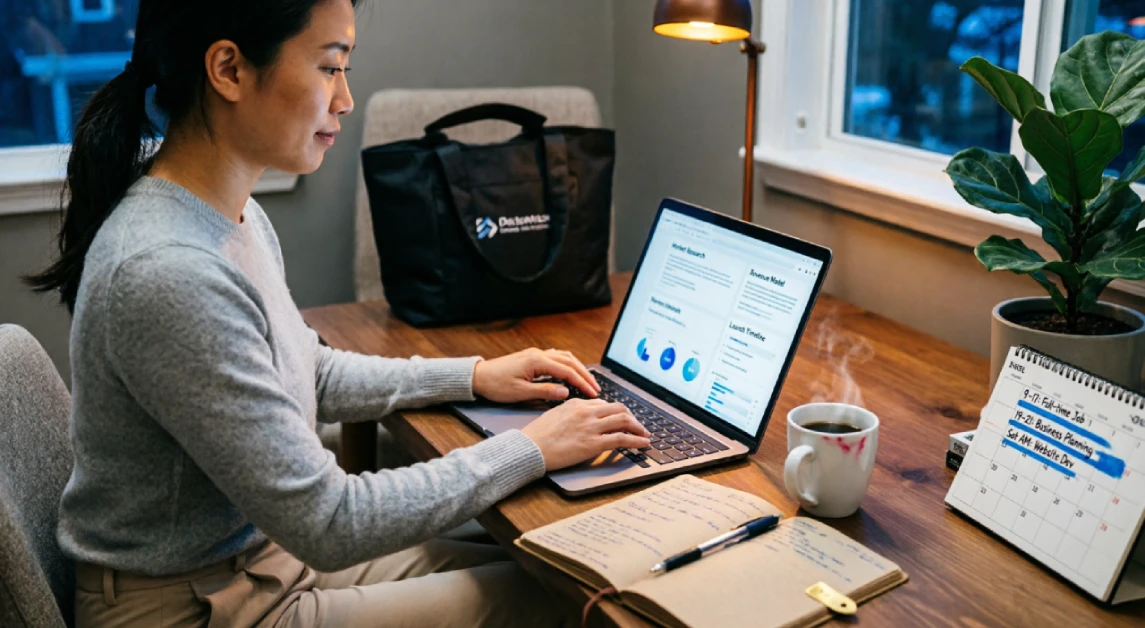
How to Start an Online Business While Working Full-Time, Here’s the thing most people get wrong — they think starting an online business means quitting their 9-to-5, moving to Bali, and posting laptop photos from a beach café.
That’s not reality. That’s Instagram.
The real story? Millions of people are building side businesses in their spare time — before work, after dinner, on weekends. And in 2026, it’s easier than it has ever been. The tools are free or cheap. The audience is already online. The barriers that once blocked ordinary people — no technical skills, no money, no connections — are smaller than ever.
But here’s the honest part: it still takes time. It still takes consistency. And most beginners fail not because they’re lazy, but because they start with the wrong model, skip basic steps, or expect results too fast.
This guide fixes all of that. Whether you’re a student with $0 to spare, a working professional with two hours per day, or someone who has tried before and got nowhere — you’ll walk away with a clear, realistic, step-by-step roadmap to starting an online business in 2026.
No fluff. No empty hype. Just practical steps that actually work.
What Is an Online Business?
An online business is any business that earns money primarily through the internet. You don’t need a physical shop. You don’t need employees. You don’t even need to meet your customers face to face.
Think of it like this:
- Rahul writes product reviews on his blog and earns a commission every time someone buys through his links. That’s affiliate marketing — an online business.
- Sara designs logos on Fiverr from her apartment in Lahore and sends finished work to clients in Canada. That’s freelancing — an online business.
- Ahmed runs a Shopify store selling phone accessories. He never holds inventory — his supplier ships directly to customers. That’s dropshipping — an online business.
All three of them started with very little money and zero employees. All three work from home (or anywhere with Wi-Fi).
That’s the beauty of an online business. The model is simple: provide value to people online, and get paid for it.
Why Start an Online Business in 2026?
This isn’t a “the internet is the future” speech. The internet IS the present. Here’s why starting now actually makes sense:
Low startup cost. Most online businesses can be started for under $100 — and many can be started for free. Compare that to a physical store, which costs tens of thousands before you even open the door.
Work from home (or anywhere). You set your own hours. You don’t commute. You can work from your bedroom, a coffee shop, or your parents’ house.
Global reach. Your customers don’t have to be in your city or even your country. A blogger in Pakistan can earn from readers in the US. A freelancer in India can serve clients in Europe.
Multiple income streams. One online business can have several income sources — ads, affiliate links, digital products, consulting — all running at the same time.
Real talk though: This is not a get-rich-quick path. Most online businesses take 6 to 18 months before they generate meaningful income. The people you see making $10,000/month didn’t get there in 30 days. They put in the work before the results showed up.
If you’re okay with that timeline, keep reading.
Types of Online Businesses You Can Start (Beginner Friendly)
Before jumping into steps, you need to know what your options are. Here are the most beginner-friendly models:
1. Affiliate Marketing
You promote other people’s products and earn a commission on every sale. No product to create. No customer service. You just drive people to a product link and get paid when they buy.
Best for: People who enjoy writing, YouTube, or social media.
2. Dropshipping
You run an online store, but you never stock any products. When someone orders, your supplier ships it directly to them. You keep the profit margin.
Best for: People who want to sell physical products without managing inventory.
3. Freelancing
You offer a skill — writing, graphic design, web development, video editing, social media management — and get paid per project or per hour.
Best for: People who already have a marketable skill and want to earn fast.
4. Content Creation (YouTube / Blog)
You build an audience by creating helpful or entertaining content. Once you have traffic, you monetize through ads, sponsorships, or affiliate links.
Best for: People with patience and a topic they know well or love talking about.
5. Selling Digital Products
You create something once — an ebook, a Notion template, a design pack, an online course — and sell it repeatedly with zero extra work per sale.
Best for: People with expertise or knowledge others would pay for.
Internal Link Suggestion #1: Link to the pillar article — “How to Start and Grow a Profitable Online Business in 2026 (Real-World Guide)” — here, with anchor text like “see a full comparison of each business model” or “explore which model fits your situation.”
How to Start an Online Business: Step-by-Step Guide
Now let’s get practical. These are the actual steps — not theory, but what you need to do, in the right order.
Step 1: Choose a Profitable Niche
A niche is your specific topic or market. “Health” is not a niche. “Weight loss for women over 40” is a niche. The tighter you go, the easier it is to stand out.
How to find your niche:
Ask yourself three questions:
- What do I know well OR enjoy learning about?
- Are people spending money in this space?
- Is there room for a new face, or is it too crowded?
Practical method: Go to Google and type your topic idea + “best products” or “how to.” If there are ads and existing blogs, there’s money in it. If the first page is dominated by massive brands with 10,000 articles, you may need a more specific angle.
Beginner mistake: Choosing a niche based purely on what makes money, not what you can actually talk about consistently. You’ll burn out within two months.
Example: Instead of “make money online” (too competitive), try “make money on Etsy for stay-at-home moms” or “passive income for teachers.”
Step 2: Choose Your Business Model
Now match your niche to a business model.
| If you have… | Start with… |
|---|---|
| No money | Freelancing or affiliate marketing (free to start) |
| A little budget ($50–$200) | Blog + affiliate marketing or dropshipping |
| A skill (writing, design, coding) | Freelancing immediately |
| Time but no money | Content creation (YouTube or blog) |
| A hobby or expertise | Digital products or content |
Don’t try to do all of them at once. Pick one. Master it. Then expand later.
Step 3: Set Up Your Platform
Your platform is where your business lives. This could be:
- A website/blog (WordPress + cheap hosting — around $3–$5/month)
- A YouTube channel (free)
- An Etsy shop or Amazon store (free to open)
- A Fiverr or Upwork profile (free for freelancers)
- An Instagram or TikTok page (free)
For most beginners, I’d recommend starting with whatever requires the least friction. If you want to freelance, set up a Fiverr profile today — it takes 20 minutes. If you want to blog, use free platforms like Medium or Blogger first before investing in hosting.
Don’t get stuck here. A lot of beginners spend three weeks designing a logo and arguing with themselves about website colors before they’ve made a single dollar. Your platform doesn’t need to be perfect on Day 1.
Step 4: Create Valuable Content or Products
This is where most beginners either shine or completely fail.
The rule is simple: solve a real problem.
If you’re blogging, write articles that answer questions people are actually searching for. If you’re freelancing, your profile should clearly explain what problem you solve for the client. If you’re selling digital products, make sure your product saves someone time, money, or effort.
Example: Instead of writing a generic article titled “10 Ways to Be Productive,” write “How I Use Google Calendar to Run My Freelance Business Without Missing Deadlines.” One is vague. The other is specific, personal, and useful.
Content creation reality check: You won’t go viral in Week 1. Write 20 blog posts, post 30 YouTube videos, or send 50 freelance proposals before you judge whether it’s working.
Step 5: Drive Traffic
No traffic = no customers = no business. Here are the main free methods:
SEO (Search Engine Optimization): Write content that targets specific search terms. When someone Googles your topic, your article or page shows up. This is slow (takes 3–6 months) but very powerful long-term.
Social Media: Share your content on Instagram, TikTok, Pinterest, LinkedIn, or Facebook groups — depending on where your audience is. TikTok is especially powerful for beginners because short videos can reach thousands without a following.
Quora and Reddit: Answer questions in your niche. Include a link to your content when relevant. This is free and can send targeted traffic quickly.
YouTube: Second biggest search engine in the world. If you can create helpful videos, even low-quality ones filmed on your phone, you can drive consistent traffic.
Cold outreach: For freelancers, simply emailing or messaging potential clients is still one of the most effective ways to land your first few gigs.
Internal Link Suggestion #2: Link to an article on your site about SEO basics or free traffic methods (e.g., “How to Get Free Traffic to Your Online Business in 2026”) with anchor text like “learn how to drive free traffic without spending a rupee.”
Step 6: Monetize Your Business
Here’s where the money comes in. Depending on your model:
- Affiliate marketer: Apply to affiliate programs (Amazon Associates, ShareASale, ClickBank) and embed links in your content.
- Blogger: Use Google AdSense for ad revenue, or promote affiliate products.
- Freelancer: Set your rates, deliver excellent work, ask for reviews, repeat.
- Dropshipper: Set product prices above your supplier’s cost. The margin is your profit.
- Digital product creator: Use Gumroad, Payhip, or your own website to list and sell.
Key point: Don’t try to monetize before you have even a tiny audience or track record. Build first. Monetize second. Beginners who slap ads on a brand-new blog with 5 visitors/day will earn $0.02 per month and quit.
How to Start an Online Business With No Money
Yes, it’s possible. Here’s how:
Free platforms to use:
- Google Sites or Blogger (free website/blog)
- Canva (free design tool)
- Mailchimp (free email list up to 500 subscribers)
- Fiverr/Upwork (free freelancer profiles)
- YouTube (free video hosting)
- Instagram/TikTok (free social media)
- Google Keyword Planner (free SEO tool)
Free traffic methods:
- SEO (takes time, but costs nothing)
- Social media posting
- Quora and Reddit answers
- Facebook groups
Realistic limitations:
When you start with no money, you trade money for time. Free platforms take longer to grow. You’ll spend more hours doing things manually that paid tools could automate. Free website builders look less professional. But this is still a completely valid way to start — just go in with realistic expectations.
Many successful freelancers and affiliate marketers started with $0 and built from there. The first $100 you earn online can fund better tools. Then the next $500. You grow incrementally.
How to Start an Online Business From Home (Beginner Tips)
Working from home sounds amazing until you realize your bed is five feet away and Netflix exists.
Here’s what actually works:
Set a dedicated workspace. It doesn’t need to be a full home office. A specific chair, a specific corner, a specific desk — your brain needs to know “this is work mode.” Working from your couch blurs the lines between rest and productivity.
Work in time blocks. If you only have 2 hours per day after your full-time job, protect those 2 hours like meetings you can’t cancel. 8 PM to 10 PM, every weekday — that’s 10 hours per week, 40 hours per month. That’s enough to build something real.
Separate your business tasks from distractions. Use your phone’s focus mode. Use website blockers like Cold Turkey or Freedom during work sessions. The biggest enemy of a home-based business isn’t lack of knowledge — it’s YouTube and Instagram.
Tell your family. If you live with others, communicate that your “business hours” are real. Interruptions during your productive window will slow you down dramatically.
Track your progress. Keep a simple weekly log: What did I do? What result did I get? Where do I need to improve? Without tracking, it’s easy to feel “busy” while making zero progress.
Common Mistakes Beginners Make (And How to Avoid Them)
These mistakes cost beginners months of wasted time. Read carefully.
Mistake 1: Trying to Do Everything at Once
Blogging, YouTube, Instagram, dropshipping, affiliate marketing — all at the same time. Result: zero progress on all fronts.
Fix: Pick ONE business model and ONE traffic source. Stay focused for at least 90 days before expanding.
Mistake 2: Waiting for the “Perfect” Moment
“I’ll start when I have more time.” “I’ll start after I finish this course.” “I’ll start next month.”
Fix: Start ugly. Start imperfect. Your first blog post doesn’t need to be a masterpiece. Your first Fiverr gig doesn’t need a perfect profile. You learn by doing, not by waiting.
Mistake 3: Giving Up Too Early
Most beginners quit right before things start working. They write 10 blog posts, get no traffic, and decide “blogging doesn’t work.” Meanwhile, successful bloggers published 80+ posts before seeing consistent traffic.
Fix: Set a realistic 6-month minimum commitment before deciding if something is working or not. Track progress in small milestones, not just income.
Mistake 4: Copying Others Exactly
Seeing someone make money with a specific niche and then doing the exact same thing — same topic, same strategy, same format — without any personal angle.
Fix: Take inspiration from what works, but bring your own perspective. Your unique experience, voice, and angle is what will make you stand out from the hundred others doing the same thing.
Mistake 5: Spending on Tools Before Earning Anything
Buying $500 worth of courses, $200 in software subscriptions, and $100 for a logo before making their first dollar.
Fix: Use free tools until you earn. Reinvest a portion of your first earnings into better tools. There is no tool that will do the work for you.
Mistake 6: Ignoring Their Audience
Creating content or products based on what they want to make, not what their audience actually needs.
Fix: Before creating anything, research your audience. What questions are they asking? What problems are they struggling with? What words do they use? Use Google, Reddit, Quora, and YouTube comments to find out.
Tools & Resources for Beginners
Here’s a practical starter toolkit — not an overwhelming list, just what actually matters:
For Research & SEO:
- Google Keyword Planner (free)
- Ubersuggest (free tier available)
- AnswerThePublic (limited free searches)
For Content Creation:
- Canva (free — for graphics, thumbnails, social posts)
- Grammarly (free — for writing quality)
- Google Docs (free — for drafting articles)
For Website/Blog:
- WordPress.org with Hostinger or Namecheap hosting (~$3–$5/month)
- WordPress.com (free version available)
- Blogger (completely free)
For Freelancing:
- Fiverr (free to join)
- Upwork (free to join)
- LinkedIn (free profile)
For Email Marketing:
- Mailchimp (free up to 500 contacts)
- MailerLite (free up to 1,000 contacts)
For Selling Digital Products:
- Gumroad (free — takes a small commission per sale)
- Payhip (free plan available)
For Affiliate Marketing:
- Amazon Associates (free)
- ShareASale (free)
- ClickBank (free)
Realistic Timeline & Expectations
Let’s be completely honest about how long this takes:
| Month | What to Expect |
|---|---|
| Month 1–2 | Setting up, learning the basics, creating first content or profile. Income: usually $0. |
| Month 3–4 | First traffic or first clients. Maybe your first $50–$200. Progress feels slow. |
| Month 5–6 | Things start connecting. Traffic grows. You understand what’s working. |
| Month 7–12 | Consistent income possible — $300 to $2,000+/month depending on model and effort. |
| Month 12+ | Scaling becomes possible. Systems in place. Income grows with less manual effort. |
The honest truth: Freelancers can earn their first income within days or weeks (because you’re trading skills for money directly). Bloggers and affiliate marketers often wait 6–12 months before meaningful income because it depends on organic traffic building up.
This doesn’t mean one is better than the other — it just means your timeline varies by model. Set your expectations accordingly and you won’t quit early.
Internal Link Suggestion #3: Link to the pillar article — “How to Start and Grow a Profitable Online Business in 2026″ — at the end of this section with anchor text like “ready to go deeper? Here’s the full roadmap to growing your online business beyond the beginner stage.”
Quick Start Checklist
Use this as your action plan. Don’t overthink it — just check off each step:
- [ ] Decide on a niche (specific topic or market)
- [ ] Research if people are searching for or spending money in that niche
- [ ] Choose one business model (affiliate, freelancing, dropshipping, etc.)
- [ ] Set up your platform (website, Fiverr profile, YouTube channel, etc.)
- [ ] Create your first piece of content OR send your first freelance proposal
- [ ] Sign up for one affiliate program OR set up one product listing (if applicable)
- [ ] Choose one traffic method and go all in on it for 90 days
- [ ] Set a daily or weekly work schedule and protect it
- [ ] Track your results weekly (traffic, income, clients)
- [ ] Review progress at the 90-day mark and adjust strategy if needed
That’s it. Ten steps. No fancy MBA required.
FAQs
How much money do I need to start an online business?
You can start with $0 using free platforms like Blogger, Fiverr, YouTube, or Instagram. If you want a professional-looking blog with a custom domain, expect to spend $30–$60/year on hosting and a domain. Most successful online businesses started with less than $100 in their first month.
Can I start an online business with no experience?
Absolutely. Most successful online business owners started with no experience. Freelancing is a great starting point if you have any existing skill — writing, design, social media management, data entry — because you can start earning while you learn. Blogging and affiliate marketing also have a very low barrier to entry, with plenty of free tutorials available.
Which online business is best for beginners in 2026?
It depends on your situation:
- Fastest to earn: Freelancing (you can land a client in your first week)
- Lowest effort to start: Affiliate marketing through social media (TikTok + Amazon affiliate is very beginner-friendly)
- Best for long-term passive income: Blogging + SEO (slow to start but powerful once established)
- Best for product sellers: Dropshipping or digital products on Etsy
Can I run an online business while working a full-time job?
Yes — and this is actually the smartest approach. Keep your full-time income as your financial safety net while building your online business on the side. Once your online income consistently covers your living expenses, then consider making the transition. Don’t quit your job first.
How many hours per week do I need?
Even 5–10 hours per week is enough to make meaningful progress if you’re focused and consistent. Two hours a day, five days a week = 10 hours/week = 40 hours/month. That’s more than enough to build something real over 6–12 months.