
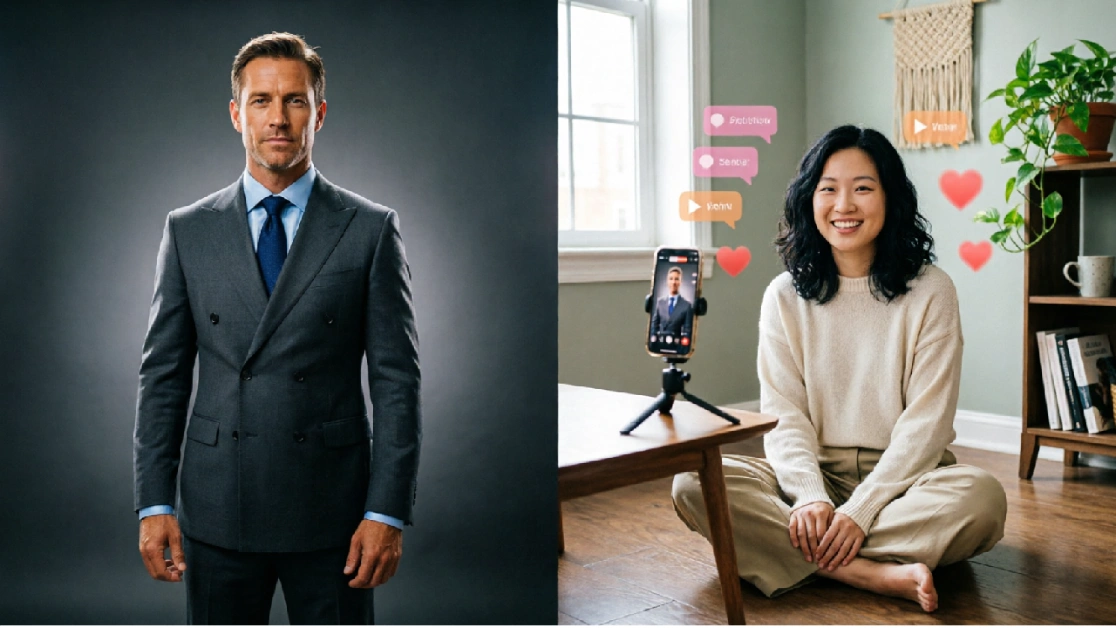
How Influencers Are Replacing Traditional Celebrities — it starts with a single moment that reveals where fame has truly gone.
A major skincare brand drops a campaign featuring a Hollywood A-lister. Same week, a 28-year-old dermatology creator on YouTube posts a 12-minute breakdown of the same product line. The celebrity’s post gets polite engagement. The creator’s video drives the brand’s biggest sales week of the year.
That gap — between recognition and actual trust — is where the entire influencer-vs-celebrity conversation lives.
What’s Actually Changing
Traditional celebrities built fame through controlled channels: film studios, record labels, TV networks, and publicists who managed every word. Fame was scarce by design. Distance was part of the product.
Influencers broke that model by doing the opposite. They built audiences through volume, consistency, and the appearance of unfiltered access. You see their apartment, their morning routine, their arguments, their retractions.
Platforms like YouTube, TikTok, and Instagram didn’t just mint new celebrities — they rewrote the rules of fame itself. They created a different type of celebrity: one whose authority comes from proximity, not polish.
This is the core shift. And it’s accelerating in 2026.
Why Influencers Are Replacing Celebrities: 4 Trust-Driven Factors
1. Direct Audience Connection
A traditional celebrity communicates to an audience. An influencer communicates with one.
Reply sections, comment pinning, community posts, live streams — these aren’t just features. They’re signals that say: I see you. When a fitness creator responds to a comment about a viewer’s knee injury and adjusts a workout recommendation on the spot, no celebrity trainer on a late-night show can match that moment.
Take a fitness creator with 600K followers: they’ll often beat celebrity-endorsed workout apps on affiliate conversions — not because they’re bigger, but because their audience feels seen.
Here’s what matters now: in 2026, influence isn’t about how many people see you — it’s about how many people actually listen.
Hidden trade-off: That closeness creates dependency. When a creator takes a week off, audience drop-off is faster and more personal than it would be for a celebrity. This parasocial dynamic — what researchers call parasocial interaction theory — creates powerful loyalty but also fragility when creators step away.
2. Authenticity vs. the Polished Image
Celebrity branding is historically built on aspiration — looking at someone’s life and wanting it. Influencer content is built on identification — looking at someone’s life and seeing yourself in it.
The scrappy apartment background, the unsponsored opinion video, the “I messed this up” retraction — these aren’t accidents. They’re a communication style that audiences in 2026 have been trained to prefer.
Real-world example: When a beauty creator posts a no-filter skincare video and mentions a product genuinely changed their skin, conversion rates often outperform celebrity-fronted campaigns — particularly when tracked through creator-specific UTM parameters and platform-native analytics like Google Analytics 4 — even when the celebrity has ten times the follower count.
Practical takeaway: Brands that still prioritize “aspirational” over “relatable” in their influencer briefs are leaving engagement on the table.
Hidden trade-off: Performed authenticity is now a well-documented phenomenon. Audiences — especially under 25 — are getting faster at detecting when “realness” is a strategy. The window for manufactured relatability is closing.
3. Faster Content Cycles
A Hollywood film takes two years from greenlight to release. A television appearance requires scheduling, rehearsal, and production. An influencer can respond to a trending topic within four hours and be the definitive voice on it before a traditional celebrity’s PR team has even drafted a statement.
This speed isn’t just a content advantage. It’s a cultural relevance advantage.
Real-world example: During major cultural moments — product launches, social conversations, viral trends — creators who move fast accumulate search traffic, saves, and shares — all trackable through GA4 and UTM parameters — that compound over time. Celebrities who respond late often feel reactive rather than relevant.
Practical takeaway: In a content calendar built around real-time culture, speed of response is its own form of authority.
Hidden trade-off: Moving fast means moving without full information. Several high-profile creators have damaged their credibility by publishing takes they later had to walk back. Velocity without judgment is a liability.
4. Niche Dominance
Traditional celebrities are generalists. Their fame is wide but thin across specific topics. An influencer who spends three years building authority in, say, sourdough bread or mechanical keyboards or Montessori parenting has a depth of trust in that niche that no general celebrity can touch.
Real-world example: A personal finance creator with 200,000 followers may drive more actual investment app sign-ups than a celebrity with 10 million followers casually mentioning money management — because the creator’s audience came specifically for that content.
Practical takeaway: For brands in specialized categories, niche influencer authority consistently outperforms broad celebrity visibility.
Hidden trade-off: Niche depth creates niche ceilings. Creators who try to expand beyond their core topic often lose the exact audience that gave them authority in the first place.
Real-World Shifts: Brands, Products, and Relevance
The numbers behind brand deals have shifted noticeably. Major consumer brands that once anchored campaigns around one or two celebrity faces are now distributing budget across dozens of micro-influencers and nano-influencers — because the combined engagement, targeting precision, and content volume outperform a single celebrity placement.
Several creators have used audience trust to launch products directly: skincare lines, coffee brands, meal prep services, online education platforms. These days, launching your own product isn’t a lucky break for creators — it’s the next logical step.
Meanwhile, some traditional celebrities have found genuine second lives online — building real creator-style audiences by dropping the PR filter and engaging authentically. Others have struggled, posting content that feels produced in a format designed to feel spontaneous, and audiences notice the mismatch immediately.
Contrarian Insight: The Stability Problem Nobody Talks About
Here’s the part the influencer-era narrative glosses over: influencers are powerful but structurally fragile.
A traditional celebrity’s career can survive a quiet two-year stretch. An influencer who goes dark for 60 days risks real algorithmic and audience decay. That content treadmill? It’s not optional — it’s the entire business model.
Traditional celebrities also carry institutional credibility that transfers across contexts. An actor can move into politics, philanthropy, or brand board positions in ways that a creator with 2 million TikTok followers typically cannot — yet. Traditional celebrities still carry weight in brand lift studies for premium categories — luxury goods, political campaigns, international markets — where creator culture hasn’t reached full saturation.
The more accurate picture isn’t “influencers are replacing celebrities.” It’s that the definition of celebrity is splitting into two parallel tracks — one built on institutional prestige, one built on audience intimacy — and the second track is currently growing faster and generating more direct commercial value.
How to Identify Who Has Real Influence Today
A simple model for cutting through follower counts and brand deal announcements:
The Real Influence Checklist
- Does their audience act on their recommendations, or just like them?
- Do they have a consistent niche — or are they chasing every trend?
- Is their engagement genuine (comments with substance) or hollow (emoji replies)?
- Have they built anything beyond content — a product, a community, a paid membership?
- What happens to their numbers when they go quiet for two weeks?
The last question is the sharpest one. Real influence survives absence. Algorithmic noise doesn’t.
Common Misconceptions Worth Correcting
“Traditional celebrities are finished.” Not accurate. Institutional fame still carries weight in premium categories — luxury goods, award shows, political campaigns, international markets where creator culture hasn’t reached full saturation. The obituary is premature.
“Influencers are always more trusted.” This depends heavily on category, audience age, and the creator’s track record. In high-stakes decisions — financial products, medical information, major purchases — trust in influencers drops sharply unless the creator has deep, verifiable expertise. Relatability is not the same as credibility.
What This Means in Practice
For audiences: You’re not just a consumer of content anymore. Your attention, comments, and purchases are direct signals that shape what gets made — and who gets paid.
For brands: The question has shifted from “who’s famous?” to “whose audience trusts them enough to act?” Those are different questions with different answers.
For creators: The opportunity is real, but the ceiling is built on consistency, niche clarity, and genuine audience relationships — not follower count alone. Which of these shifts impacts your strategy most? Drop your take below — or save this analysis for your next campaign planning session.