
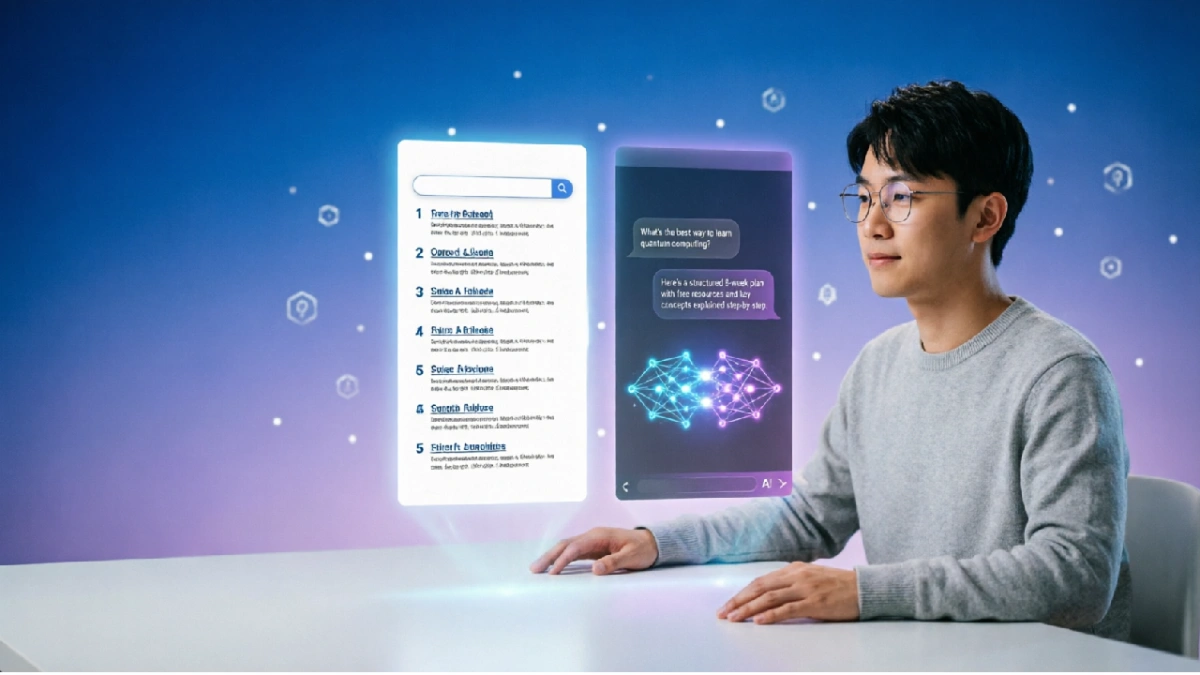
Google Search vs AI Search: The Future of Online Information in 2026. For more than two decades, Google Search has been the default way people find answers online. You type a few words, scan a page of results, open a link, and decide for yourself which source deserves your trust.
In 2026, that habit is changing.
AI search tools now answer questions directly. Instead of sending users to a list of pages, they summarize information, compare options, explain topics, and let people ask follow-up questions in a natural conversation. Google itself has also moved deeper into AI with AI Overviews and AI Mode, making the line between a traditional search engine and an AI answer engine much thinner.
So the real question is not whether Google Search is dead. It is not. The better question is this: how will Google Search and AI search work together, compete, and reshape the way people discover information online?
What Is Google Search in 2026?
Google Search is still a powerful search engine built around crawling, indexing, ranking, and organizing web pages. When someone searches, Google tries to show the most useful results based on relevance, quality, location, freshness, authority, and search intent.
But Google Search in 2026 is no longer just a page of blue links.
Modern Google results may include:
- AI-generated summaries
- Featured snippets
- Shopping results
- Videos
- Images
- Local map packs
- People Also Ask boxes
- Forum discussions
- News results
- Traditional organic links
- Paid ads
This means Google is now a hybrid search experience. It still points users to websites, but it also answers many questions directly on the results page.
For users, this can be faster. For publishers, bloggers, and businesses, it creates a harder challenge: ranking on page one is no longer always enough if users get their answer before clicking.
What Is AI Search?
AI search is a search experience where an artificial intelligence system gathers information, understands the question, and produces a direct answer.
Instead of showing ten links and asking the user to do the research, AI search tries to do part of the research for them.
AI search tools can:
- Summarize complex topics
- Compare products or ideas
- Answer follow-up questions
- Explain information in plain language
- Pull from current web results
- Cite or reference sources
- Create step-by-step guidance
- Personalize responses based on context
Examples include ChatGPT search, Perplexity-style answer engines, Bing generative search, and Google’s own AI search features.
The biggest difference is the user experience. Google Search traditionally says, “Here are the best pages.” AI search says, “Here is the answer, and here are the sources behind it.”
Google Search vs AI Search: The Core Difference
The main difference between Google Search and AI search is control.
Google Search gives users more control over what they open, compare, and trust. AI search gives users a faster answer, but with more interpretation done by the system.
Here is the simple breakdown:
| Feature | Google Search | AI Search |
|---|---|---|
| Main format | Ranked results and search features | Direct conversational answers |
| User effort | User scans and compares sources | AI summarizes the answer |
| Best for | Research, local search, shopping, current news, source discovery | Explanations, comparisons, planning, quick learning |
| Weakness | Can feel crowded or ad-heavy | Can make mistakes or over-summarize |
| Trust model | User judges sources directly | User must judge the AI answer and its sources |
| Follow-up questions | Limited in classic search | Built into the experience |
Neither model is perfect. Google Search can overwhelm people with too many results. AI search can sound confident even when it needs more verification.
That is why the future is likely not “Google or AI.” It is “Google plus AI, with users switching based on the task.”
Why AI Search Is Growing So Fast
AI search is growing because it matches how people naturally ask questions.
A traditional Google query might look like this:
“best laptop for video editing under 1000 2026”
An AI search query might look like this:
“I need a laptop under $1,000 for editing YouTube videos, light gaming, and schoolwork. I care more about battery life than screen size. What should I compare?”
That second query is more human. It includes context, priorities, trade-offs, and intent. AI search handles that kind of question better because it can respond conversationally.
People are also using AI search because it reduces the number of steps between question and answer. Instead of opening five tabs, comparing paragraphs, dodging pop-ups, and piecing together the answer, users get a summary first.
That convenience is powerful.
Where Google Search Still Wins
Google still has major advantages in 2026.
First, Google has one of the most mature web indexes in the world. It is extremely good at finding pages, understanding freshness, identifying local intent, and organizing different types of content.
Second, Google is deeply connected to everyday online behavior. People use it for maps, business hours, product searches, images, videos, flights, definitions, weather, news, and quick facts. AI search is improving, but Google remains part of the internet’s daily muscle memory.
Third, Google is often better when users want to inspect sources themselves. If you are comparing legal information, medical guidance, product reviews, financial topics, or breaking news, you may not want only a summary. You may want original documents, expert pages, forums, reviews, and multiple viewpoints.
Google Search is still especially useful for:
- Finding official websites
- Checking local businesses
- Comparing shopping options
- Reading recent news
- Exploring multiple opinions
- Finding images and videos
- Verifying original sources
- Navigating to known brands
In short, Google is still excellent when discovery matters.
Where AI Search Wins
AI search wins when users want clarity instead of a list.
If someone asks, “What is the difference between Wi-Fi 6 and Wi-Fi 7?” an AI answer can explain it in plain English, give a comparison table, and suggest which one matters for different users.
That is much faster than opening several articles and building the answer manually.
AI search is strong for:
- Learning unfamiliar topics
- Summarizing long information
- Comparing choices
- Planning trips or projects
- Explaining technical ideas
- Creating checklists
- Translating complex language
- Asking follow-up questions
The follow-up experience is especially important. Traditional search often starts over with every query. AI search can remember the conversation and refine the answer.
For example, a user can ask:
“What is the best smart home setup for a small apartment?”
Then follow up with:
“Make it cheaper.”
Then:
“Only include devices that work with Apple Home.”
That kind of conversational filtering is where AI search feels less like a search box and more like a research assistant.
The Problem With Trust
The biggest challenge for AI search is trust.
AI answers can be helpful, but they can also be incomplete, outdated, or wrong. The danger is that AI responses often sound polished even when the underlying answer needs more caution.
Google Search has trust problems too. Search results can include ads, SEO-heavy content, outdated pages, low-quality reviews, and pages written mainly to rank. But users can still open different sources and compare them directly.
With AI search, the answer may combine information from multiple places into one smooth response. That makes the experience easier, but it can hide disagreement, uncertainty, or missing context.
In 2026, smart users need a new search habit: use AI for understanding, but verify important decisions with original sources.
That matters for topics like:
- Health
- Law
- Finance
- Safety
- Politics
- Breaking news
- Product claims
- Technical troubleshooting
AI search is useful. It should not be treated as automatically final.
What This Means for Website Owners
For website owners, bloggers, and businesses, the shift from Google Search to AI search changes the visibility game.
In the old model, the goal was simple: rank high on Google and earn clicks.
In the new model, content may appear inside AI summaries, answer boxes, or generated responses. Users may see your information without visiting your site. This creates a difficult reality: visibility and traffic are no longer the same thing.
That does not mean websites are becoming useless. It means websites need to become more useful.
Thin content is easier for AI to summarize and replace. Strong content gives people a reason to click, trust, save, subscribe, or buy.
In 2026, content creators should focus on:
- Original experience
- Clear expertise
- Real examples
- Fresh data
- Strong opinions backed by reasoning
- Helpful visuals
- Product testing
- First-hand reviews
- Practical steps
- Author credibility
AI can summarize common knowledge. It is much harder for AI to replace original insight, lived experience, hands-on testing, and trusted brand authority.
SEO Is Becoming Answer Optimization
SEO is not disappearing. It is changing.
Traditional SEO focused on helping pages rank in search engines. In 2026, content also needs to be understandable to AI systems that summarize, cite, and extract answers.
This does not mean stuffing articles with keywords. That approach feels outdated and unnatural.
Instead, good SEO now means writing content that is:
- Clear
- Well-structured
- Accurate
- Helpful
- Easy to summarize
- Built around real user questions
- Supported by expertise
- Updated when facts change
Headings matter. Concise definitions matter. Tables matter. FAQ sections matter. So do direct answers that make it easy for both humans and AI systems to understand the point.
The best content in 2026 serves two readers at once: the human who wants a useful answer and the AI system trying to understand what the page is about.
Will AI Search Replace Google?
AI search will not fully replace Google in 2026, but it will change how people use Google.
Many searches will still begin on Google because it is familiar, fast, and deeply connected to the web. But more users will turn to AI search when they want explanations, recommendations, summaries, or help making decisions.
Google also knows this, which is why it is building AI directly into Search. The future is not a clean battle between old Google and new AI tools. The future is a blended search experience where every major search platform becomes more conversational.
The real competition is over who controls the answer layer.
In the past, websites competed for rankings. Now platforms compete to become the place where users receive the final answer.
The Future of Online Information in 2026
The future of online information will be faster, more conversational, and more personalized. But it will also require more digital judgment from users.
AI search will make it easier to learn quickly. Google Search will remain essential for discovery, verification, and navigating the web. Publishers will need to create content worth trusting, not just content designed to rank.
The biggest winners will be users who know when to use each tool.
Use AI search when you want a fast explanation, a comparison, or a starting point.
Use Google Search when you want original sources, multiple viewpoints, local details, fresh updates, or deeper verification.
The search habit of 2026 is not about choosing one side. It is about knowing which tool gives you the right kind of answer.
Conclusion
Google Search vs AI Search is not a simple winner-takes-all story. Google is becoming more AI-driven, and AI search tools are becoming more search-aware.
For everyday users, this means faster answers and more conversational research. For content creators, it means the old traffic model is under pressure. For businesses, it means trust, authority, and originality matter more than ever.
In 2026, the future of online information belongs to platforms that can answer quickly, cite clearly, and help users verify what matters.
The web is not going away. But the way people reach it is changing fast.
FAQs
Is AI search better than Google Search?
AI search is better for quick explanations, summaries, comparisons, and follow-up questions. Google Search is better for finding original sources, local results, recent news, products, images, videos, and multiple viewpoints.
Will Google Search disappear because of AI?
No. Google Search is not likely to disappear in 2026. Instead, it is becoming more AI-powered through features like AI summaries and conversational search experiences.
What is the biggest risk of AI search?
The biggest risk is trusting a confident answer without checking the original source. AI search can summarize information well, but it can still miss context, use outdated information, or make errors.
How should bloggers adapt to AI search?
Bloggers should focus on original insights, first-hand experience, clear structure, fresh information, helpful examples, and trustworthy authorship. Generic content is easier for AI systems to replace.
Is SEO still important in 2026?
Yes. SEO is still important, but it now includes optimizing for both traditional search results and AI-generated answers. Clear, useful, well-structured content has become even more important.